Why Structure Alone Is Not Enough
A compact data format must do more than reduce token usage. It must preserve the information an AI agent needs to interpret data correctly.
The following examples explore a fundamental distinction between data structure and data meaning.
A dataset can be perfectly valid, yet impossible to interpret correctly without additional context. Field names, numerical values, and data types do not always reveal the rules governing those values.
Arkadia Data addresses this problem through positional records, shared schemas, and semantic comments.
We begin with one illustration, then look at size and answer accuracy separately. Five detailed cases evaluated across three model families follow the main results.
1. Clinical Trial: When Data Lacks Meaning
Consider a clinical trial dataset.
Question: How many patients receiving the active drug recovered before the study ended and experienced pain reduction?
{
  "trial": [
    {"p_id": "P1", "arm": "A", "days": 14, "pain_delta": -5},
    {"p_id": "P2", "arm": "B", "days": 90, "pain_delta": -4},
    {"p_id": "P3", "arm": "B", "days": 21, "pain_delta": 3},
    {"p_id": "P4", "arm": "B", "days": 18, "pain_delta": -6}
  ]
}
The structure is valid, but three essential definitions are missing:
Treatment: Which arm received the active drug?
Recovery: Does
days=90indicate recovery on day 90 or a patient who did not recover during the study?Pain: Does a negative
pain_deltaindicate improvement or worsening?
Without these definitions, the question cannot be answered reliably.
The problem is not JSON itself. The data lacks the semantics required to interpret it.
JSON with Metadata: Correct Meaning, More Tokens
We can provide the missing definitions using a separate _meta object:
{
  "_meta": {
    "arm": "A = placebo, B = active drug.",
    "days": "Right-censored at 90: days=90 means patient did NOT recover during the study.",
    "pain_delta": "Negative values mean pain reduction (improvement); positive means worsening."
  },
  "trial": [
    {"p_id": "P1", "arm": "A", "days": 14, "pain_delta": -5},
    {"p_id": "P2", "arm": "B", "days": 90, "pain_delta": -4},
    {"p_id": "P3", "arm": "B", "days": 21, "pain_delta": 3},
    {"p_id": "P4", "arm": "B", "days": 18, "pain_delta": -6}
  ]
}
Now the correct answer is 1 patient (P4).
P2 received the active drug and experienced pain reduction but did not recover before the study ended. P3 recovered but experienced increased pain. Only P4 satisfies all three conditions.
Arkadia Data with Semantic Comments
Arkadia Data separates field definitions from record values and allows semantic annotations to appear alongside the schema.
/* arm: A=placebo, B=drug.
days=90 means right-censored (not recovered).
pain_delta < 0 means improvement */
<trial:<[p_id:string,arm:string,days:number,pain_delta:number]>>
$size=4
([
("P1","A",14,-5),
("P2","B",90,-4),
("P3","B",21,3),
("P4","B",18,-6)
])The answer remains 1 patient (P4).
Instead of repeating field names for every patient, Arkadia Data declares the schema once and records values positionally.
Semantic comments preserve the definitions needed to interpret those values without introducing additional fields into the decoded records.
The objective is to remove structural repetition without removing meaning.
This clinical example is illustrative and was not included in the five-case benchmark below.
Token comparison:
| Representation | Tokens | Meaning included? |
|---|---|---|
| JSON | 116 | No |
| JSON + metadata | 184 | Yes |
| Arkadia Data + comments | 95 | Yes |
Size: comparing compact representations
On the 8 bundled datasets shaped like agent payloads (o200k_base tokens):
| dataset | JSON (indent 2) | JSON min | TOON | Arkadia Data compact |
|---|---|---|---|---|
| analytics | 4,858 | 3,141 | 2,071 | 1,991 |
| config | 279 | 152 | 182 | 168 |
| employees | 7,535 | 4,831 | 3,228 | 3,155 |
| logs | 9,215 | 5,911 | 4,122 | 3,980 |
| orders | 7,242 | 4,167 | 3,930 | 2,619 |
| rag-chunks | 2,351 | 1,913 | 1,656 | 1,689 |
| repositories | 3,568 | 2,083 | 2,507 | 1,358 |
| tool-results | 2,599 | 1,956 | 1,636 | 1,647 |
| all 8 datasets | 37,647 | 24,154 | 19,332 | 16,607 |
Against minified JSON, the compact-to-compact comparison, Arkadia Data uses 31.2% fewer tokens overall. The reduction is 55.9% against JSON with two-space indentation and 14.1% against TOON — the gap to TOON is widest on nested data because Arkadia Data's header nests too. It is not a clean sweep: minified JSON is smaller for a single irregular object, and TOON's unquoted strings win by a little on text-heavy records.
The most important change since 0.1 is not a number: JSON → Arkadia Data → JSON returns the original for every document we tested — TOON's own spec fixtures and thousands of generated documents with mixed lists, records whose keys differ from the header, nested lists and empty keys. Earlier versions could lose data on such inputs.
Token counts alone prove nothing. Independent tests of TOON showed that savings can come with lower accuracy on some models and data shapes, and that generating a new format can fail where JSON does not (Matveev, critical analysis). The same questions apply to Arkadia Data, so we measured them.
This measures representation size on eight datasets, not answer accuracy. These percentages cannot be combined with accuracy scores from the separate experiment below.
Answer accuracy: a separate experiment
This experiment covers 32 datasets and six representations. Its JSON baseline uses two-space indentation; minified JSON was not tested for answer accuracy. It therefore cannot establish that Arkadia Data preserves accuracy relative to minified JSON.
The benchmark (make benchmark in the arkadia-data repository) takes the 8 bundled datasets (employees, orders, logs, search results, RAG chunks, repositories, a configuration, a time series) and 24 generated ones (seed 7): flat tables, wide tables with up to 16 columns, orders with nested customers and items, events with optional fields, documents with several tables, configurations and lists of numbers. From each dataset it writes up to 16 questions whose answers are computed from the data, 474 in total, of 15 kinds, from "what is the city of order ORD-2017" to "how many tickets are urgent and open".
Each dataset is sent once per format with all its questions, and the reply is scored exactly: numbers by value, lists in any order, text without quotes and case. The format definition is included for Arkadia Data (~95 tokens) and TOON. The model was gpt-5.4-mini with its default reasoning effort, run twice on the same task inventory. One question’s city-name spelling changed between runs, as noted below.
Accuracy and prompt tokens in this experiment
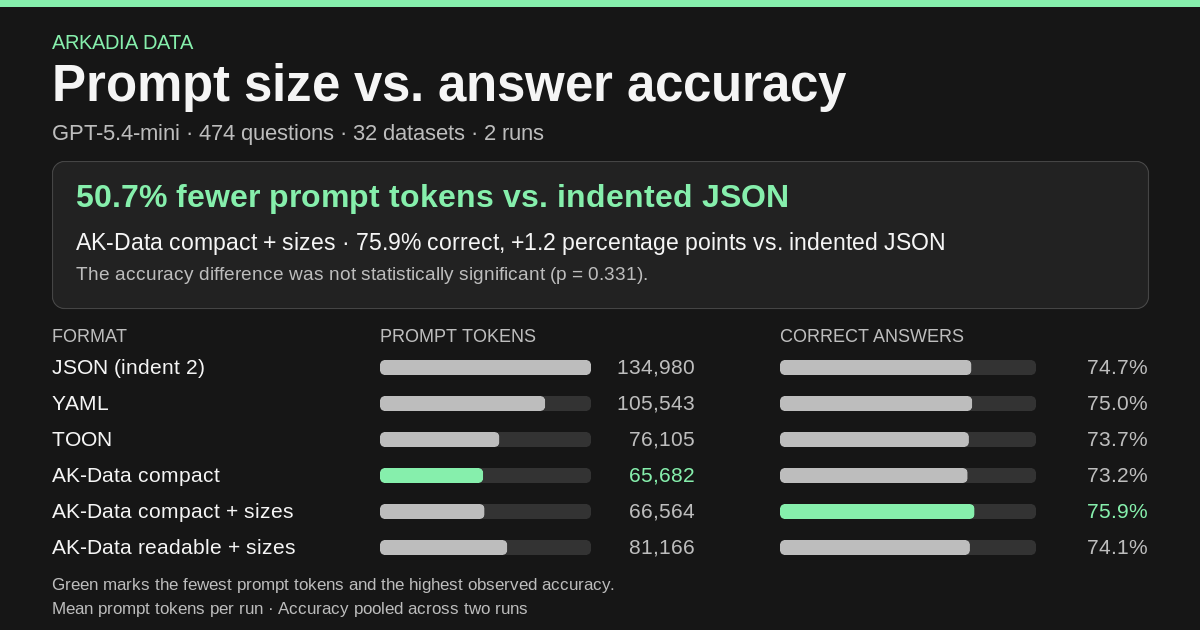
| format | run 1 | run 2 | both | 95% interval | mean prompt tokens / run | right / 10k tok |
|---|---|---|---|---|---|---|
| JSON (indent 2) | 74.1% | 75.3% | 74.7% | 71.8–77.3% | 134,980 | 26.2 |
| YAML | 74.3% | 75.7% | 75.0% | 72.1–77.7% | 105,543 | 33.7 |
| TOON | 73.0% | 74.5% | 73.7% | 70.8–76.4% | 76,105 | 45.9 |
| AK-Data compact | 74.3% | 72.2% | 73.2% | 70.3–75.9% | 65,682 | 52.8 |
| AK-Data compact + sizes | 77.2% | 74.7% | 75.9% | 73.1–78.6% | 66,564 | 54.1 |
| AK-Data readable + sizes | 73.6% | 74.5% | 74.1% | 71.2–76.7% | 81,166 | 43.2 |
The combined column pools 948 answer attempts on 474 questions; these are repeated questions, not 948 independent tasks. Intervals are descriptive Wilson intervals over those attempts. Prompt tokens are the mean per run; efficiency uses total correct answers divided by total prompt tokens.
Download source report: run 1 · Download source report: run 2. The linked run-2 scores use the same report as the published results explorer. The extraction-accuracy, paired-comparison and question-type tables are generated from these two source reports with python3 scripts/article-results.py.
Observed accuracy varies between these two runs. They provide a limited view of repeatability, not an estimate of a general noise floor. Across both runs, compact Arkadia Data scored 73.2%, JSON 74.7%, and compact Arkadia Data with sizes 75.9%. No statistically significant difference against JSON was detected in the unadjusted paired tests below; this does not establish equivalence.
The paired test: same question, different result
Overall accuracies do not show which answers differ. Questions answered correctly in both formats do not distinguish them. The paired comparison counts questions where only one format was correct. For each pair we count them over both runs and ask whether the split is more than chance (exact McNemar test).
| pair (A vs B) | only A right | only B right | p | verdict |
|---|---|---|---|---|
| YAML vs JSON (indent 2) | 48 | 45 | 0.836 | no statistically significant difference detected |
| TOON vs JSON (indent 2) | 50 | 59 | 0.444 | no statistically significant difference detected |
| AK-Data compact vs JSON (indent 2) | 46 | 60 | 0.206 | no statistically significant difference detected |
| AK-Data compact + sizes vs JSON (indent 2) | 70 | 58 | 0.331 | no statistically significant difference detected |
| AK-Data compact + sizes vs AK-Data compact | 61 | 35 | 0.010 | A ahead (unadjusted) |
| AK-Data compact + sizes vs TOON | 62 | 41 | 0.048 | A ahead (unadjusted) |
| AK-Data readable + sizes vs AK-Data compact + sizes | 48 | 66 | 0.111 | no statistically significant difference detected |
Adding list sizes raised observed accuracy from 73.2% to 75.9%: 61 paired attempts were gained and 35 lost compared with plain compact Arkadia Data (unadjusted p = 0.010). Against JSON, the size-annotated variant gained 70 and lost 58 (p = 0.331). These are exploratory comparisons: multiple pairs were tested, questions repeat across runs, and questions from the same dataset share a prompt. The p-values are unadjusted and do not account for that clustering. They should not be read as proof of general superiority or equivalence.
Where the formats differ, and where none helps
| question type | n | JSON | YAML | TOON | AK | AK+size | AK rd+size |
|---|---|---|---|---|---|---|---|
| lookup | 101 | 99% | 99% | 98% | 99% | 99% | 99% |
| position | 64 | 80% | 81% | 80% | 83% | 85% | 80% |
| extreme (max / min) | 53 | 70% | 65% | 58% | 52% | 59% | 60% |
| count | 47 | 35% | 43% | 45% | 39% | 44% | 41% |
| length | 37 | 91% | 92% | 100% | 97% | 100% | 100% |
| fields | 31 | 100% | 100% | 100% | 100% | 100% | 100% |
| nested | 30 | 100% | 98% | 98% | 100% | 100% | 95% |
| value | 25 | 100% | 100% | 100% | 100% | 100% | 100% |
| filter | 23 | 33% | 26% | 26% | 28% | 28% | 22% |
| count2 (two conditions) | 19 | 39% | 34% | 29% | 29% | 47% | 34% |
| aggregate (sum) | 13 | 15% | 19% | 0% | 4% | 8% | 8% |
| optional field | 10 | 20% | 40% | 35% | 30% | 40% | 45% |
| contains | 8 | 56% | 56% | 56% | 50% | 50% | 50% |
| inner-sum | 8 | 69% | 69% | 69% | 81% | 62% | 50% |
| null | 5 | 20% | 10% | 10% | 10% | 30% | 40% |
Green marks perfect scores and the highest score in each row when formats differ and at least half the answers were correct.
Retrieval of individual values, field names and nested paths was more reliable than filtering, counting or arithmetic in these datasets. Explicit list sizes let the model read a declared length rather than count records. The table reports observed performance, not a guarantee for other workloads.
For sums and filters that require exact results, compute them with code and let the model explain the result. One question changed between the reports: run 1 used a literal JSON escape for Kraków, while run 2 used the city name directly. The statistics align this question by its unchanged target and expected answer; the prompts are not identical. The source reports preserve both wordings.
Meaning in practice: five detailed cases
The following is a separate, small experiment about interpreting meaning supplied alongside data. Its results should not be combined with the size or extraction-accuracy benchmarks above.
Benchmark Methodology
To evaluate whether AI models can interpret semantic comments, we constructed five synthetic scenarios containing information that cannot be reliably inferred from the records alone.
Each scenario was evaluated in four representations:
| Representation | Description |
|---|---|
| JSON | Records without explanatory metadata |
| JSON + metadata | Records with a separate _meta object |
| Arkadia Data | Positional records without comments |
| Arkadia Data + comments | Positional records with semantic comments and size annotations |
Three models were evaluated:
OpenAI GPT-5.4-mini
Anthropic Claude Haiku 5.5
Google Gemini 3.5 Flash-Lite
The experiment consisted of 60 API calls: five scenarios, four representations, three models, and one trial per combination.
Each model was instructed to answer using only the supplied data and to return a specific output format.
The following sections present the annotated JSON and Arkadia Data representations, explain the expected answer, and report the actual model responses across all four variants.
Token counts refer to the exact complete prompts used in the experiment, including instructions and questions, rather than the reformatted examples displayed in this article.
2. Accounting: Reversed Signs and Currency Units
Financial systems may use sign conventions that differ from a model's default assumptions.
In this example, positive transaction values indicate cash outflows, negative values indicate inflows, and certain transaction IDs represent simulations.
Question: What is the net cash change, in full PLN, from completed PLN transactions, excluding dry-run simulations?
JSON with Metadata
{
  "_meta": {
    "debit_delta": "Positive = cash outflow (-cash), negative = cash inflow (+cash), so cash change = -debit_delta. PLN/EUR in minor units (1/100), JPY in 1:1.",
    "tx_id": "IDs >= 900 are dry-run simulations and must be excluded."
  },
  "ledger": [
    {"tx_id": 101, "curr": "PLN", "debit_delta": 15000},
    {"tx_id": 102, "curr": "PLN", "debit_delta": -40000},
    {"tx_id": 901, "curr": "PLN", "debit_delta": -50000},
    {"tx_id": 103, "curr": "JPY", "debit_delta": -1000}
  ]
}
Arkadia Data with Semantic Comments
/* tx_id>=900 is dry-run (ignore).
debit_delta: + is outflow (-cash), - is inflow (+cash),
so cash change = -debit_delta.
PLN in minor units (1/100), JPY 1:1 */
<ledger:<[tx_id:number,curr:string,debit_delta:number]>>
$size=4
([
(101,"PLN",15000),
(102,"PLN",-40000),
(901,"PLN",-50000),
(103,"JPY",-1000)
])Correct Interpretation
The model must apply three rules: reverse the sign of debit_delta, convert PLN subunits into full PLN, and exclude dry-run simulations.
Only completed PLN transactions are considered.
(−15000 + 40000) / 100 = 250
Expected answer: 250 PLN.
Actual Model Responses
| Model | JSON | JSON + meta | AK-Data | AK + comments |
|---|---|---|---|---|
| GPT-5.4-mini | −25000 ✗ | 250 ✓ | −25000 ✗ | 250 ✓ |
| Claude Haiku 5.5 | −75000 ✗ | 250 ✓ | −75000 ✗ | 250 ✓ |
| Gemini 3.5 Flash-Lite | −75000 ✗ | 250 ✓ | −75000 ✗ | 250 ✓ |
All three models answered correctly when semantic metadata was provided, regardless of representation.
Without metadata, none produced the expected result.
Token comparison:
| JSON + metadata | AK-Data + comments | Reduction |
|---|---|---|
| 234 | 174 | 25.6% |
This case demonstrates that semantic comments can express nonstandard sign conventions, monetary units, and transaction exclusions while reducing prompt size.
3. IoT Telemetry: Error Codes and Conditional Units
Sensor readings are not always directly comparable.
A numerical value may represent a valid measurement, an error code, or a quantity expressed in different units depending on the sensor's operating mode.
Question: What was the highest actual pressure, in bars, recorded by a functioning sensor?
JSON with Metadata
{
  "_meta": {
    "pressure": "999.9 indicates sensor fault (ignore). Mode 1 is in bars; in mode 2, readings > 500 are in decibars (divide by 10 for bars, otherwise already in bars)."
  },
  "sensors": [
    {"id": "S1", "mode": 1, "pressure": 120.5},
    {"id": "S2", "mode": 1, "pressure": 999.9},
    {"id": "S3", "mode": 2, "pressure": 650.0},
    {"id": "S4", "mode": 2, "pressure": 140.0}
  ]
}
Arkadia Data with Semantic Comments
/* pressure: 999.9 = sensor error (ignore);
mode 1 is bars;
in mode 2, readings >500 are decibars (divide by 10);
readings <=500 are bars */
<sensors:<[id:string,mode:number,pressure:number]>>
$size=4
([
("S1",1,120.5),
("S2",1,999.9),
("S3",2,650.0),
("S4",2,140.0)
])Correct Interpretation
| Sensor | Raw reading | Actual pressure |
|---|---|---|
| S1 | 120.5 | 120.5 bar |
| S2 | 999.9 | Invalid |
| S3 | 650.0 | 65.0 bar |
| S4 | 140.0 | 140.0 bar |
Expected answer: 140 bar.
Simply selecting the largest recorded number would produce an incorrect answer.
Actual Model Responses
| Model | JSON | JSON + meta | AK-Data | AK + comments |
|---|---|---|---|---|
| GPT-5.4-mini | 650.0 ✗ | 120.5 ✗ | 999.9 ✗ | 140 ✓ |
| Claude Haiku 5.5 | 650.0 ✗ | 140 ✓ | 650.0 ✗ | See below * |
| Gemini 3.5 Flash-Lite | 999.9 ✗ | 140.0 ✓ | 650.0 ✗ | 140.0 ✓ |
Claude Haiku 5.5 responded:
The highest is S4 at 140.0
This response contains the correct pressure and identifies the correct sensor. However, the prompt explicitly required the model to return only the final number.
Consequently, the automatic evaluator marked the answer as incorrect.
This distinction matters because the model interpreted the metadata correctly but failed to follow the required output format.
Under strict answer matching, both metadata representations achieved 2/3 correct responses in this scenario.
Under semantic evaluation, Arkadia Data with comments achieved 3/3 correct interpretations, while JSON with metadata achieved 2/3.
Token comparison:
| JSON + metadata | AK-Data + comments | Reduction |
|---|---|---|
| 202 | 170 | 15.8% |
The result illustrates why benchmark evaluations should distinguish reasoning accuracy from output-format compliance.
It also provides an example where a model produced the correct semantic answer in Arkadia Data but not in JSON with metadata. One trial is insufficient to establish a general advantage.
4. Security: Privileges and Account Suspension
Security systems often use numerical conventions that contradict familiar assumptions.
A lower numerical role level may indicate greater privilege rather than less, while a separate field may indicate whether the account is currently active.
Question: Which user currently holds active highest-level privileges in the system?
JSON with Metadata
{
  "_meta": {
    "role_level": "Ring security convention: 0 = highest privilege (root), 5 = lowest (guest).",
    "deny_mask": "Bitmask of active blocks. Any value > 0 suspends the account completely."
  },
  "iam": [
    {"user": "alice", "role_level": 5, "deny_mask": 0},
    {"user": "bob", "role_level": 0, "deny_mask": 4},
    {"user": "charlie", "role_level": 0, "deny_mask": 0},
    {"user": "dave", "role_level": 1, "deny_mask": 0}
  ]
}
Arkadia Data with Semantic Comments
/* role_level: 0 is highest (root), 5 is lowest.
deny_mask > 0 means the account is suspended */
<iam:<[user:string,role_level:number,deny_mask:number]>>
$size=4
([
("alice",5,0),
("bob",0,4),
("charlie",0,0),
("dave",1,0)
])Correct Interpretation
Alice has the lowest privilege level.
Bob has root-level privileges but is suspended.
Charlie has root-level privileges and no suspension.
Dave has lower privileges than Charlie.
Expected answer: charlie.
Actual Model Responses
| Model | JSON | JSON + meta | AK-Data | AK + comments |
|---|---|---|---|---|
| GPT-5.4-mini | alice ✗ | charlie ✓ | alice ✗ | charlie ✓ |
| Claude Haiku 5.5 | alice ✗ | charlie ✓ | alice ✗ | charlie ✓ |
| Gemini 3.5 Flash-Lite | alice ✗ | charlie ✓ | alice ✗ | charlie ✓ |
All three models selected Alice without metadata, apparently following the assumption that a higher numerical role level represents greater privilege.
With metadata, every model correctly selected Charlie.
Token comparison:
| JSON + metadata | AK-Data + comments | Reduction |
|---|---|---|
| 194 | 136 | 29.9% |
This case demonstrates that models can use Arkadia Data comments to interpret domain-specific authorization rules even when the underlying numerical convention differs from common expectations.
5. E-Commerce: Metadata at the Record Level
Some metadata describes an entire field. Other metadata applies only to a specific record.
This distinction becomes important when datasets include synthetic transactions, test records, or values that must be excluded from calculations.
Question: What is the total refunded amount, in EUR, across real orders?
JSON with Metadata
{
  "_meta": {
    "orders": {
      "size": 5,
      "fields": {
        "st": "1 new, 2 paid, 3 shipped, 4 refunded",
        "amount": "EUR cents"
      },
      "test_records": [999]
    }
  },
  "orders": [
    {"id": 101, "st": 2, "amount": 1250},
    {"id": 102, "st": 4, "amount": 899},
    {"id": 103, "st": 3, "amount": 2400},
    {"id": 104, "st": 4, "amount": 4500},
    {"id": 999, "st": 4, "amount": 100000}
  ]
}
Arkadia Data with Semantic Comments
<orders:<[
id:number,
st:number /* 1=new, 2=paid, 3=shipped, 4=refunded */,
amount:number /* EUR cents */
]>>
$size=5
([
(101,2,1250),
(102,4,899),
(103,3,2400),
(104,4,4500),
/* test record */
(999,4,100000)
])Arkadia Data places the explanations directly alongside the elements they describe.
The st comment defines the status codes, the amount comment specifies the currency subunit, and the annotation before order 999 identifies that record as test data.
Correct Interpretation
Orders 102 and 104 are refunded real orders.
Order 999 is also marked as refunded but must be excluded because it is test data.
(899 + 4500) / 100 = 53.99
Expected answer: 53.99 EUR.
Actual Model Responses
| Model | JSON | JSON + meta | AK-Data | AK + comments |
|---|---|---|---|---|
| GPT-5.4-mini | 5399 ✗ | 53.99 ✓ | 5399 ✗ | 53.99 ✓ |
| Claude Haiku 5.5 | 5399 ✗ | 53.99 ✓ | 5399 ✗ | 53.99 ✓ |
| Gemini 3.5 Flash-Lite | 5399 ✗ | 53.99 ✓ | 5389 ✗ † | 53.99 ✓ |
† Gemini excluded the test order but added 899 + 4500 as 5389.
All three models returned the correct result when metadata was present.
Without metadata, none produced the correct amount.
Token comparison:
| JSON + metadata | AK-Data + comments | Reduction |
|---|---|---|
| 218 | 157 | 28.0% |
This example illustrates an important characteristic of Arkadia Data: semantic comments can be positioned at both the field and record levels without becoming additional decoded fields.
However, the position of a comment should not be confused with a formally enforced record association. Preserving that association during transformations requires explicit parser and serializer behavior.
6. HR Systems: Semantics That Change Over Time
The meaning of a value may change over time, even when its field name and data type remain unchanged.
Consider an employee evaluation system that changed its grading scale between 2025 and 2026.
Question: Which bonus-eligible employees achieved the top performance grade in their respective review year?
JSON with Metadata
{
  "_meta": {
    "grade": "In 2025: 1-5 scale (5 = best). In 2026: German 1-6 scale (1 = best, 5 = poor).",
    "contract": "EXT contractors are excluded from the bonus pool."
  },
  "reviews": [
    {"emp": "E1", "yr": 2025, "contract": "PERM", "grade": 5},
    {"emp": "E2", "yr": 2025, "contract": "PERM", "grade": 1},
    {"emp": "E3", "yr": 2026, "contract": "PERM", "grade": 5},
    {"emp": "E4", "yr": 2026, "contract": "EXT", "grade": 1},
    {"emp": "E5", "yr": 2026, "contract": "PERM", "grade": 1}
  ]
}
Arkadia Data with Semantic Comments
/* grade: in 2025 5=best;
in 2026 1=best (reversed scale).
contract="EXT" is excluded from bonus */
<reviews:<[emp:string,yr:number,contract:string,grade:number]>>
$size=5
([
("E1",2025,"PERM",5),
("E2",2025,"PERM",1),
("E3",2026,"PERM",5),
("E4",2026,"EXT",1),
("E5",2026,"PERM",1)
])Correct Interpretation
The highest possible grade in 2025 was 5, while the highest grade in 2026 was 1.
External contractors are not eligible for bonuses.
E1 qualifies under the 2025 scale. E5 qualifies under the 2026 scale.
E3 does not have a top grade under the revised system, and E4 is excluded as a contractor.
Expected answer: E1, E5.
Actual Model Responses
| Model | JSON | JSON + meta | AK-Data | AK + comments |
|---|---|---|---|---|
| GPT-5.4-mini | E1, E3 ✗ | E1, E5 ✓ | E1, E3 ✗ | E1, E5 ✓ |
| Claude Haiku 5.5 | E1, E3 ✗ | E1, E5 ✓ | E1, E3 ✗ | E1, E5 ✓ |
| Gemini 3.5 Flash-Lite | E1, E3 ✗ | E1, E5 ✓ | E1, E3 ✗ | E1, E5 ✓ |
All three models produced the correct answer when metadata was provided.
Without metadata, every model selected E1 and E3, applying an incorrect assumption about the grading scale.
Token comparison:
| JSON + metadata | AK-Data + comments | Reduction |
|---|---|---|
| 263 | 183 | 30.4% |
This case demonstrates that semantic comments can communicate context-dependent interpretation rules without modifying the underlying record structure.
Metadata: comments the decoder ignores, the model uses
A separate test asks 27 questions about four annotated datasets, 15 of which need a fact written only in the metadata: what status code 2 means, that amounts are in hundredths of a złoty (12350 means 123.50 PLN), which records are tests. The model was gpt-5.4-mini, run twice on the same questions; the other 12 questions need only the data.
| variant | prompt tokens | needs metadata, run 1 | needs metadata, run 2 | other (both runs) |
|---|---|---|---|---|
| JSON | 2,632 | 7% | 13% | 100% |
| JSON + notes | 2,876 | 93% | 93% | 100% |
| AK-Data, no metadata | 1,970 | 20% | 20% | 100% |
| AK-Data + /* comments */ | 2,233 | 87% | 87% | 100% |
| AK-Data + $attributes #tags | 2,182 | 73% | 73% | 100% |
| AK-Data + comments + attributes | 2,442 | 80% | 80% | 92% |
Among the Arkadia Data variants, plain words work best: /* status: 0 unpaid, 1 paid, 2 cancelled */ lifted the metadata questions from 20% to 87% in both runs, at 2,233 tokens against 2,876 for JSON with the same facts as notes (93% in both runs). On 15 questions the 6-point gap is one question. Structured attributes ($enum="0=unpaid,…") were weaker: 73% in both runs. Comments and attributes together reached 80%, but missed one of the 12 questions that need only the data.
What this does not show
- The full benchmark of 474 questions was run on one model, twice. The five detailed cases are a separate test: three models, one trial each. Claude (Anthropic) and Gemini (Google) runs of the full benchmark are being prepared and will appear on the results page. Two runs are insufficient to establish a general noise floor or reliably characterize small differences between formats.
- The model's reasoning effort was left at its default. More reasoning may raise the counting and arithmetic scores in every format; this was not tested.
- The data is synthetic, shaped like agent payloads; your data may behave differently.
make benchmark DIR=./my-jsonruns the same test on it. - The source reports differ in the spelling of one city-name question; this limits direct repeatability comparisons.
- The first run kept only the wrong answers; the second recorded every prompt and reply, and that is the run on the results page.
Check every answer yourself
The results page lists all 474 questions with the expected answer and each format's reply. Open any question to see the exact prompt and run the code that computes the right answer in your browser.
To reproduce the whole run (about 530,000 prompt tokens across the six formats):
make benchmark NETWORK=1 MODEL=gpt-5.4-mini      # arkadia-data repository
make analyze                                       # paired tests, weak types, misses
make benchmark NETWORK=1 MODEL=gpt-5.4-mini RANDOM=48 TRIALS=3 REASONING=low
Is it still worth it?
It is a fair question. TOON appeared about a year before this article, and context windows now reach a million tokens or more. If everything fits anyway, why another format?
A large window is a limit, not a price. Input tokens are still billed on each call, and an agent that works in a loop sends the same payload again and again. How much that costs varies: prompt caching makes repeated input much cheaper, and prices differ between models and between the tokens a model reads and the ones it writes. Models also tend to find details less reliably as the context grows. A payload half the size is cheaper under any of these prices, and it matters most when it is sent thousands of times a day.
Fewer tokens alone are not a reason to switch. Prices keep falling, prompt caching removes part of the difference, and models have seen far more JSON than anything else. In this test neither Arkadia Data nor TOON was significantly more accurate than JSON. What is left to gain depends on what you send today. On the 8 bundled datasets Arkadia Data compact needs 31.2% fewer tokens than minified JSON. Against TOON the difference is 14.1%, which alone rarely justifies changing a pipeline that already uses it.
A bigger window does not explain the data. A model can read a million tokens and still not know that 1250 means 12.50, that status 2 means cancelled, or that one row is a test record. In the metadata test a plain comment next to the field lifted those questions from 20% to 87%, at 2,233 prompt tokens against 2,876 for JSON carrying the same facts as notes. That is what the format is for: the note sits next to the schema, field or record it describes, the decoder ignores it, and the data still converts back to the original JSON.
| worth it when | not worth it when |
|---|---|
| the same data is sent many times: agent loops, tool results, retrieved records | the payload is small and sent once |
| the values need explaining: units, codes, reversed signs, records to exclude | the field names already say everything |
| people and models should read the same text, with comments in it | every tool in the pipeline must parse the format without a new library |
| the model reads the data | the model must write the data and nothing checks it afterwards; JSON is the safer choice there |
So the answer is yes, but not because of the window. It is worth it for the cost of each call and, more than that, for carrying what the values mean. Do not take that on trust: make benchmark DIR=./my-json runs the same test on your own data.
Try it
Arkadia Data (AK-Data) is MIT-licensed. Version 0.3.1 is available onPyPI, npm, crates.io and Homebrew.
Command line
See the install section or get a binary download.
brew install arkadia-solutions/tap/ak-data
# Or install via Cargo:
cargo install arkadia-dataecho '{"users":[{"id":1,"name":"Ada"}]}' | ak-data -c
# Output: <users:<[id:number,name:string]>>([(1,"Ada")])Python
pip install arkadia-dataimport arkadia.data as akd
print(akd.dumps([{"id": 1, "name": "Ada"}]))JavaScript
npm install @arkadia/dataimport { encode } from '@arkadia/data';
console.log(encode([{ id: 1, name: 'Ada' }]));Agent skills
Agent Skills (a SKILL.md file an agent loads when a task needs it) are read by more than 30 agent tools. Two Arkadia Data skills cover it: ak-data-install sets up arkadia-data or @arkadia/data and uses the ak-data command, and ak-data-format teaches the format itself: how to read Arkadia Data and how to answer in it with a declared header.
To see it without code, copy one of the example prompts into ChatGPT or Gemini. If you run the benchmark on your models or data, we'd like to see the report.
Summary
Size: On eight bundled datasets, compact Arkadia Data used 31.2% fewer tokens than minified JSON. This is a comparison of compact representations; savings depend on the shape of the data.
Answer accuracy: In a separate experiment on 32 datasets and 474 questions, across two runs of GPT-5.4-mini, Arkadia Data compact with list sizes scored 75.9%, compared with 74.7% for JSON with two-space indentation. The difference was not statistically significant, which does not prove equivalence. Minified JSON was not included in that experiment, so its accuracy remains untested here.
The meaning of a value matters as much as its format. The examples show why it helps to spell out units, status codes and which records to exclude. The model still struggled to filter rows and add up values across formats. For those tasks, let code do the calculation and give the model the result to explain.